If you are trying to work out how to choose an air fryer, the fastest way is to ignore the marketing and focus on five things: size, basket style, controls, cleaning and value. Most buyers do not need the biggest model or the one with the most presets. They need the one that fits their household, their kitchen space and the way they cook.
A good air fryer should make everyday meals easier. It should heat up quickly, cook evenly enough for the food you make most often, and be simple to clean after use. If it misses on those basics, extra functions will not make up for it.
See Our Top 10 Picks
Here are the 10 best models we tested and ranked to help you choose faster.
View Best ProductsHow to choose an air fryer for your home
Start with capacity. This is usually the biggest factor in whether you are happy with your purchase after the first week.
For one person, a small air fryer is often enough. Something around 2 to 4 litres works well for chips, chicken portions, vegetables and reheating leftovers. For two people, 4 to 6 litres is usually the safer choice, especially if you want to cook a full meal rather than side dishes.
Families often need more room than they first expect. If you regularly cook for three or more people, look at larger baskets or dual-drawer models. A single large basket can be good for batch cooking, but dual drawers are often easier if you cook different foods at the same time.
Do not just buy the largest model you can afford. Bigger air fryers take up more worktop space and can feel wasteful for small portions. If you mostly cook for one or two people, a very large model may be slower to live with and harder to store.
Basket, drawer or oven style?
This is where comparisons matter. Air fryers are sold in a few main formats, and each suits a different type of buyer.
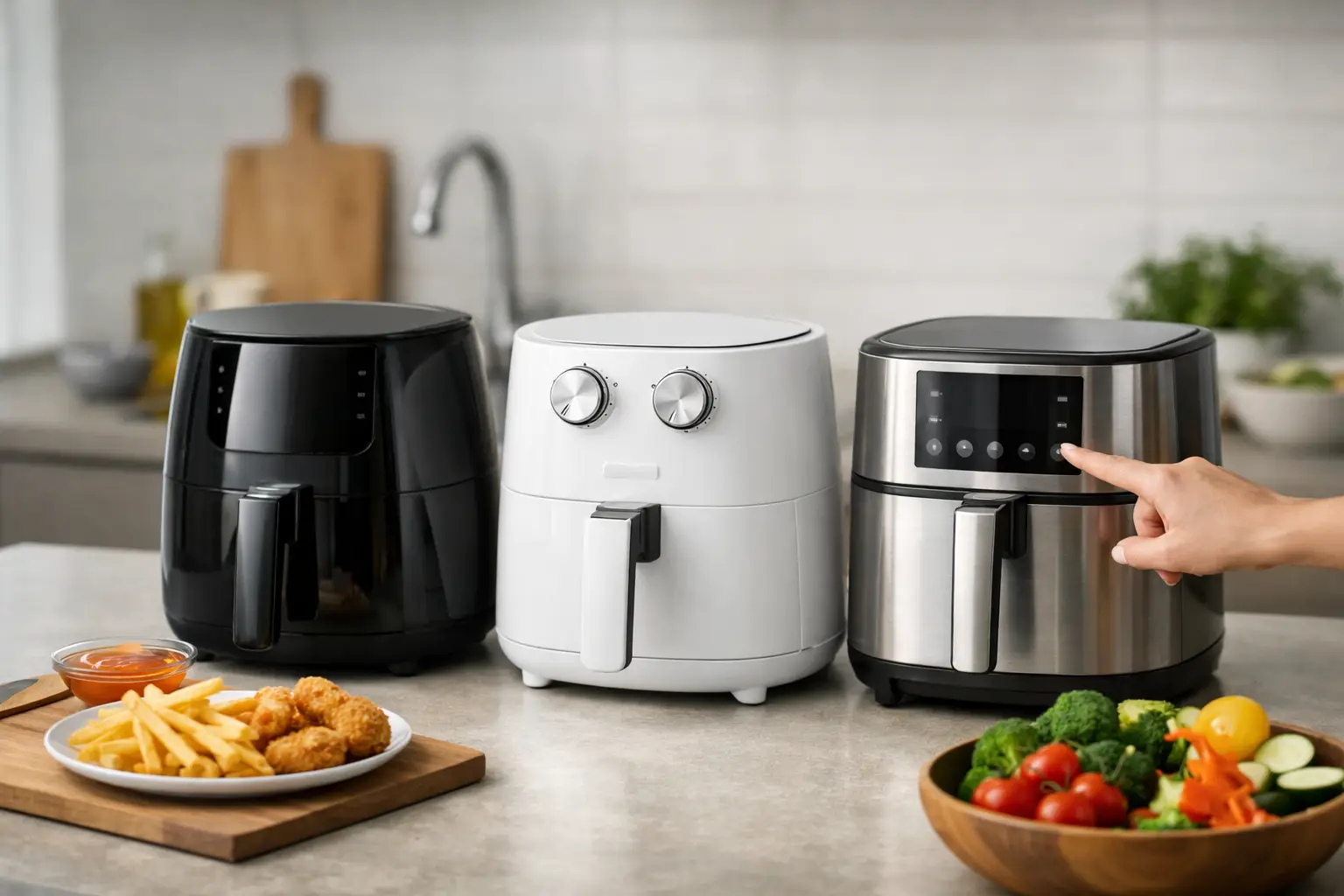
Basket air fryers are the most common. They are usually the easiest to use and the best option for buyers who want quick meals with minimal fuss. You slide out the basket, add food, set the time and temperature, and shake when needed. For chips, frozen food, chicken and simple meals, they are often the best choice.
Dual-drawer air fryers suit households that cook more than one item at once. You can keep chips in one drawer and chicken in the other, or cook two foods at different temperatures and times. This adds flexibility, but it also adds size and cost. They make most sense if you will use both drawers regularly.
Oven-style air fryers give you shelves instead of a pull-out basket. They can be useful if you want a more versatile appliance for pizza, toast, baking or larger items. The trade-off is that they are not always as simple or as quick for everyday use. Some also need more attention to get even results across different shelves.
If speed and convenience are your priority, a basket model is usually the simplest answer. If flexibility matters more, consider dual-drawer or oven-style models.
The features that actually matter
Many buyers spend too long comparing presets and not enough time looking at the basics.
Power matters, but only to a point. Higher wattage can mean faster heating and cooking, but it is not a guarantee of better performance. A well-designed air fryer with moderate wattage can still beat a more powerful model with poor airflow. Treat wattage as a useful clue, not the deciding factor.
Temperature range is worth checking. Most air fryers cover the temperatures needed for everyday cooking, but a wider range can help if you want to dehydrate, bake or cook more gently. If you only want crispy frozen food and simple meals, standard ranges are usually fine.
Controls make a bigger difference than many buyers expect. Manual dials are simple and quick. Digital controls look smarter and often give more precision. Neither is automatically better. If you want speed and ease, manual can be enough. If you like exact settings and timed programmes, digital may suit you better.
Presets are useful if they are clear and sensible. They are not a reason on their own to choose one model over another. Most people end up adjusting time and temperature anyway.
A viewing window can be handy, especially if you are new to air fryers, but it is not essential. The same goes for app control. These extras sound helpful, but for many buyers they add little day-to-day value.
How to choose an air fryer that is easy to live with
An air fryer can look great in product photos and still be awkward in a real kitchen.
Check the external size, not just the internal capacity. Some models have large footprints, tall bodies or drawers that need extra space in front when fully open. Measure your worktop before buying, especially if the air fryer will sit under cupboards.
Weight matters too. If you plan to store it away between uses, a heavy or bulky model may become annoying very quickly. A slightly smaller model you use every day is better than a huge one that stays in a cupboard.
Noise is rarely the top buying factor, but some models are noticeably louder than others. If your kitchen is open plan or you cook early in the morning, this can matter more than you think.
Cable length is easy to overlook. Short cables can limit where the air fryer fits safely. You do not want to rely on an extension lead for a worktop cooking appliance.
Cleaning matters more than extra functions
For many households, cleaning decides whether an air fryer becomes a daily appliance or a rarely used one.
Look for non-stick baskets and trays that are easy to wipe down. Dishwasher-safe parts are helpful, but hand washing still tends to keep non-stick coatings in better condition over time. What matters most is whether the drawer, tray and corners are easy to access.
Grill plates, crisper trays and multi-part accessories can improve cooking, but they also create more to wash up. If you want a low-maintenance air fryer, simpler is often better.
Read product details carefully around coatings and removable parts. A basket that feels sturdy and slides smoothly is usually a better sign than a long list of accessories.
Price and value
The cheapest air fryer is not always the best value. Low-cost models can still be excellent for basic use, but very cheap options sometimes compromise on controls, build quality or ease of cleaning.
Mid-range models are often the strongest value for most UK shoppers. This is where you are most likely to find a good balance of capacity, reliable cooking, easy controls and practical cleaning. Premium models make sense if you want a larger size, dual drawers or more flexible cooking modes, but not every buyer needs to pay extra.
When comparing price, think about what you will actually use. Paying more for smart features, rotisserie accessories or complex cooking modes is hard to justify if you mainly want chips, chicken and quick weeknight meals.
A better way to compare models is to ask three questions. Does it fit the right number of portions? Is it simple enough that you will use it often? Is it easy to clean after a normal meal? If the answer is yes to all three, it is probably good value.
Common buying mistakes
The most common mistake is buying too small. Air fryers need space around the food for hot air to circulate. If the basket is cramped, food cooks less evenly and crispness suffers. If you regularly cook more than one portion, give yourself more room than you think you need.
The second mistake is buying too large without a reason. Large models can be excellent, but only if you need the space. Otherwise, they take up room and cost more for little practical benefit.
Another mistake is focusing too much on headline features. A touchscreen, a long preset list or app support may look impressive, but they do not guarantee better results. Build quality, usable capacity and cleaning are usually more important.
Some buyers also underestimate the difference between a single basket and dual drawers. If you often cook mixed meals, dual drawers can be worth the extra cost. If you mostly cook one item at a time, a single basket is often the better buy.
A quick way to narrow your options
If you want to compare models faster, start with your household size and cooking habits. One or two people who mainly cook simple meals should usually look at single-basket models in the small to medium range. Families or buyers who cook full meals at once should look at larger baskets or dual-drawer models.
Then narrow by kitchen space. Remove any model that is too wide, too deep or too tall for your worktop. After that, compare controls and cleaning. If two models are similar on capacity and price, the easier one to use and clean is usually the smarter choice.
This is also where a product comparison page helps. Instead of reading every product description from scratch, you can compare the few factors that actually affect day-to-day use and ignore the rest.
How to choose an air fryer without overthinking it
Choose the size for your household first. Choose the format based on whether you cook one food or several at once. Then prioritise easy controls, practical cleaning and a shape that fits your kitchen.
That approach will rule out most unsuitable models very quickly. You do not need the most expensive air fryer. You need the one that matches your cooking, your space and your budget well enough that you will use it often.